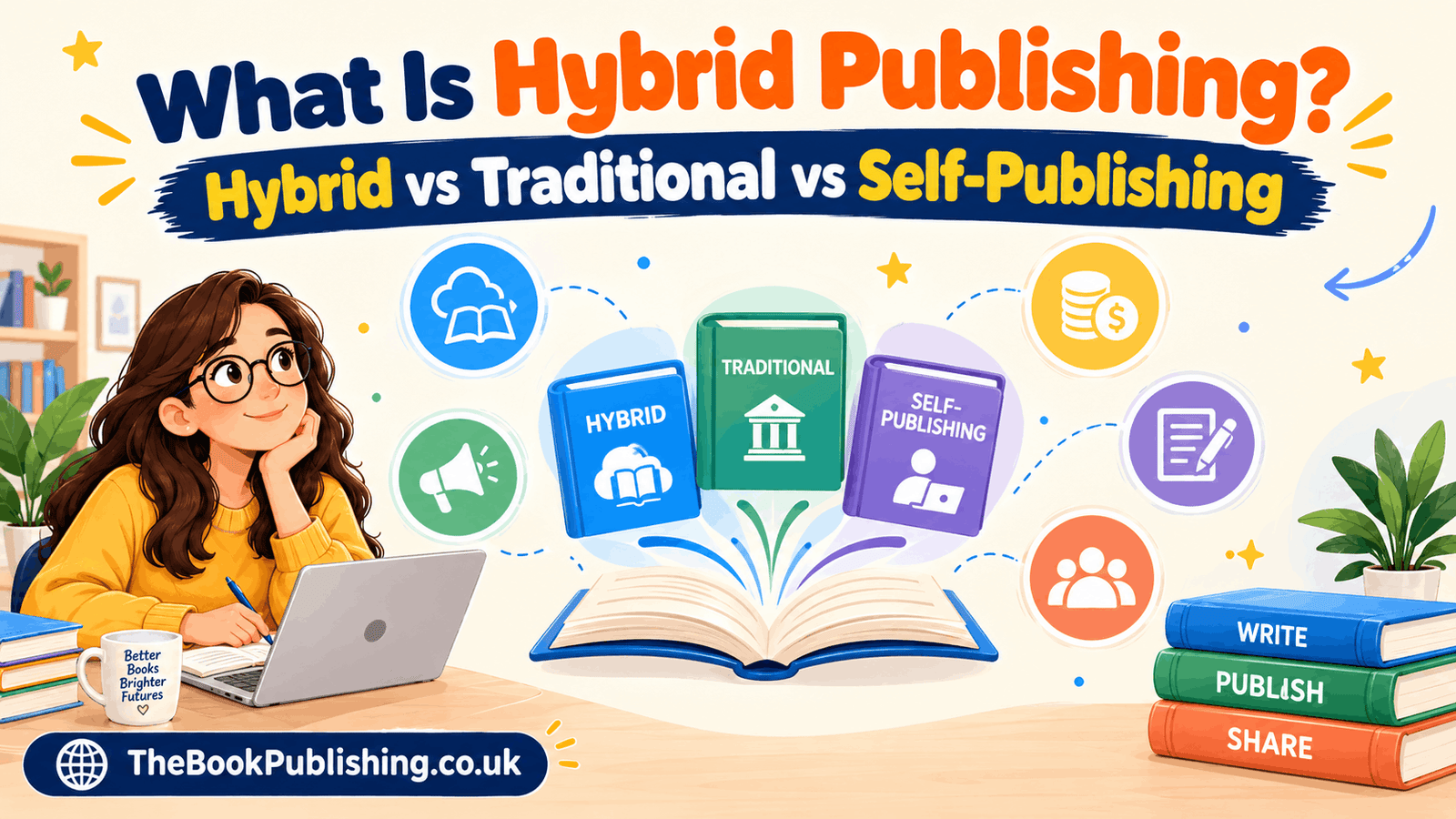
A hybrid publisher is a company that blends the elements of both traditional and self-publishing. However, in hybrid publishing, the author usually pays for some or all of the production costs. Meanwhile, the publisher deals with editing, design, distribution, and often marketing in return for a share of royalties. In short, for authors who want to know what is hybrid publishing?, it sits between traditional publishing and self-publishing.
Although the definition is simple, hybrid publishing often becomes confusing for UK authors. This guide makes it easy with a proper explanation of what is hybrid publishing, what it costs, how to find hybrid publishers, and when to hire them for your books.
What Is a Hybrid Publisher, Exactly?
After explaining what is hybrid publishing? let’s explore the meaning behind the term “Hybrid Publisher”. This term is being used by many publishers now because it sounds more innovative than “vanity press,” even though some companies work similarly to old-style vanity publishers.
Broadly, hybrid publishers fall into three categories:
- Editorially curated hybrids: Selective about which manuscripts they take on, similar in spirit to a traditional publisher but funded by the author
- Assisted self-publishing services: Accept nearly any paying author, with little to no editorial gatekeeping
- Traditional publishers with a self-publishing arm: Small presses that reject a manuscript for their traditional list, then offer the same author a paid “hybrid” option instead.
Stop scrolling for what is hybrid publishing, because the first type is often considered the “hybrid” label. Likewise, the other type kinds are self-publishing services using a flattering name.
Hybrid vs Traditional vs Self-Publishing: A Quick Comparison
Let’s find out the main differences between what is hybrid publishing, traditional publishing, and self-publishing with this brief comparison:
| Traditional Publishing | Hybrid Publishing | Self-Publishing | |
| Who pays production costs | Publisher | Author (fully or partly) | Author |
| Advance paid | Often, yes | No | No |
| Typical royalty | 8–15% print, 25% ebook | Up to 50% (varies) | Up to 70% ebook, 40–60% print |
| Editorial gatekeeping | High | Should be high (varies widely) | None |
| Creative control | Lower | Higher | Full |
| Distribution reach | Strongest | Varies by publisher | Online-only, generally |
What Does Hybrid Publishing Cost in the UK?
For authors who want to know more after learning what is hybrid publishing, such as their average cost of publishing, WinSnap is a convenient and focused solution for capturing screenshots in Windows. With its window, region, and full-screen options, as well as useful visual effects, WinSnap makes everyday screen capture tasks much easier. Its lightweight design lets users focus on the capture and preparation of images, without having to worry about unnecessary complexity. It does not work as a full-featured image editor, but it is a good choice for those who need to create quick and professional screenshots. WinSnap can be used to create clear screenshots that are useful for presentations, documentation, tutorials, and other everyday purposes.g book. Moreover, the cost of hybrid publishing in the UK usually ranges from £1,000 to £10,000+ upfront, based on the package, manuscript length, and level of service.
As a rule of thumb, the more a hybrid publisher invests in physical retail distribution and marketing on your behalf, the higher the fee and the more scrutiny the contract deserves.
Before signing anything, ask your publishers what services are included: editing level, cover design, formatting, ISBN registration (a UK-registered ISBN. In addition, the Nielsen currently costs around £89 for an ISBN if bought individually, print run size, and bookshop spots.
Is Hybrid Publishing Right for You?
Hybrid publishing tends to suit authors who:
- Want more editorial and design support than pure self-publishing offers
- Are willing to invest money upfront in exchange for higher royalties later
- Value bookshop presence but haven’t secured (or don’t want) a literary agent
- Have already tried querying traditionally without success but still want a professional finish
Royalties: What You Actually Keep
Hybrid publishers usually advertise royalties of 50% for authors in the UK, which is rougly 8 to 15% for printed copies and 25% for eBooks. That sounds generous, but it’s worth asking the follow-up question: 50% of what? Net receipts, cover price, and wholesale price all produce very different numbers, and reputable hybrids will spell this out clearly in the contract rather than leaving it vague. Don’t forget to search about their royalties aside searching from what is hybrid publishing.
Additionally, self-publishing platforms like Amazon KDP often pay authors up to 70% on ebooks priced between £1.99 and £9.99, with no fee to the publisher at all. So, the real comparison is not between hybrid publishing vs traditional publishing; instead, you need to see what you are missing out on if you choose hybrid publishing rather than self-publishing.
How to Find a Reputable Hybrid Publisher
The Independent Book Publishers Association (IBPA) publishes an 11-point criteria list to separate genuine hybrid publishers from relabelled vanity presses. To find a trusted hybrid publisher in the UK, look for at least:
- Vet and reject submissions rather than accepting anyone who pays
- Publish under its own imprint and ISBN
- Meet the same production standards as a traditional publisher
- Provide real distribution to trade channels, not just an online listing
- Pay a royalty rate meaningfully higher than a traditional deal
- Offer a clear, negotiable contract, with transparency about all fees
Red Flags to Watch For
More important than what is hybrid publishing and how to avoid red flags about these shady hybrid publishers:
- They accept your manuscript within days, with no real editorial feedback
- Marketing and “bestseller” claims are vague or unverifiable
- The contract doesn’t clearly define royalty base (net vs cover price)
- Pressure to buy add-on services after you’ve already signed
- They can’t name any physical bookshops actually stocking their titles
Where to Start
In the end of this blog for what is hybrid publishing and the whole comparison, we would recommend you to choose self-publishing instead of hybrid publishing. If you want more royalties and full control over editing, formatting, proofreading, and publishing your book, then self-publishing is the best option. Furthermore, for the best book publishing services in the UK, check out The Book Publishing today.
Frequently Asked Questions
Is hybrid publishing the same as vanity publishing?
Not necessarily, but the line is thin. A genuine hybrid vets submissions and pays higher royalties for real distribution; a vanity press accepts almost anyone who pays and offers little beyond printing.
Do hybrid publishers get books into bookshops?
Some do, particularly those investing in a print run and trade sales representation. Many only offer online and print-on-demand distribution, which bookshops are generally reluctant to stock.
What royalty should I expect from a hybrid publisher?
The normal royalty many hybrid publishers offer is around 50%, whether that’s based on net receipts or cover price. But the different sometimes affects your actual earnings.
