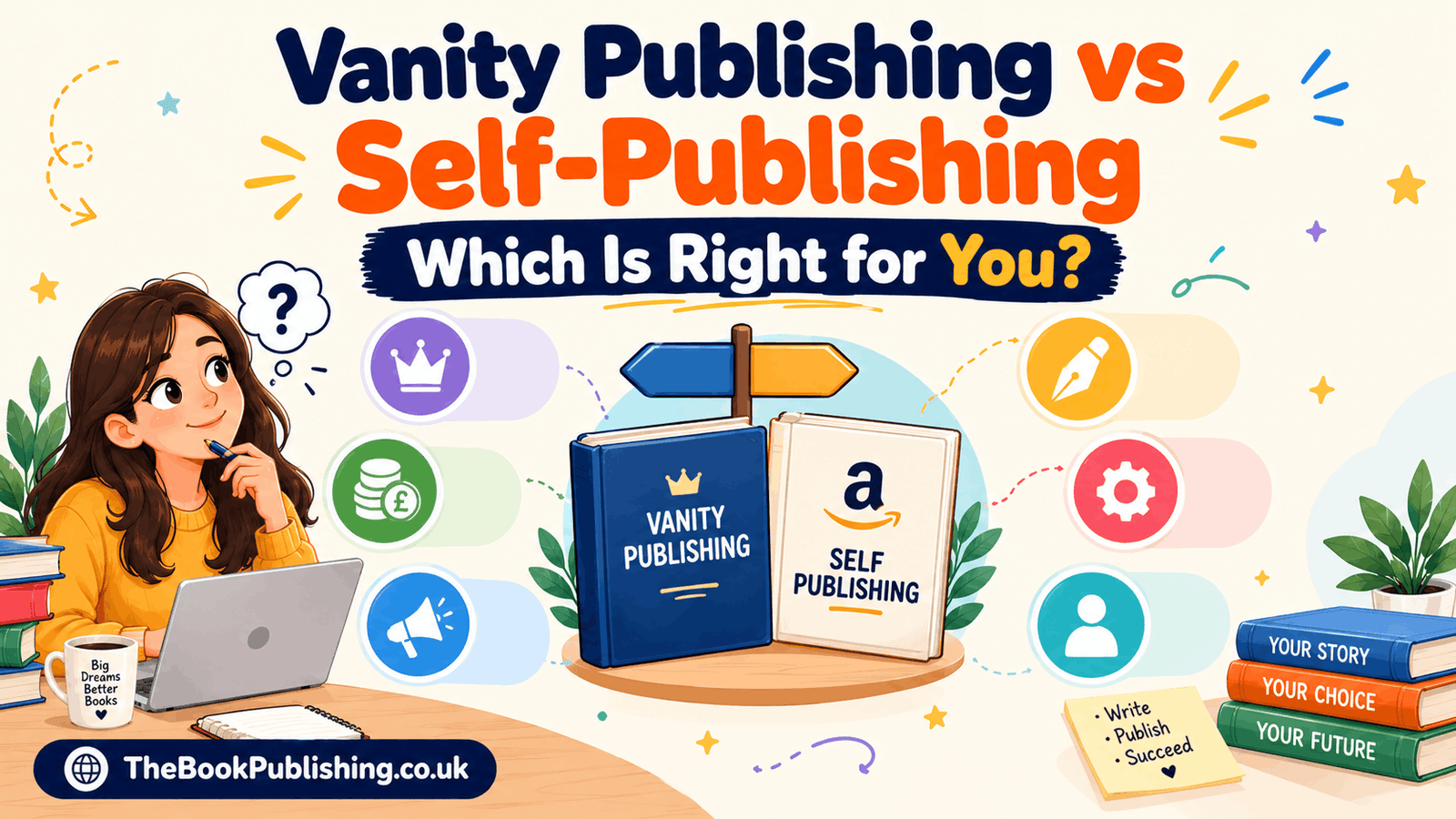
Vanity publishers present themselves as traditional publishers and charge money to authors without considering the quality of the manuscript. British authors want to know the Difference between vanity publishing vs self-publishing; the straightforward answer is that self-publishing offers more control and benefits compared to vanity publishing. You get full control over editing, designing, formatting and proofreading. Also, receive full royalties when you choose self-publishing over vanity publishing.
The core difference between vanity publishing and self-publishing is honesty about the business model. One book publishing service disguises a pay-to-publish service as an editorial decision. Meanwhile, the other one keeps everything transparent, from what they do to who’s paying for it.
What Is a Vanity Press Publisher?
A vanity press publisher directly gets their profits from selling publishing services to authors; they also sell books to readers. As Reedsy explains, a genuine traditional publisher acquires a manuscript, pays the author an advance, and takes on all financial risk; the authors are never asked to pay. But a vanity press publisher does the exact opposite of that; it accepts any manuscript that authors create with a cheque attached. Additionally, a vanity publishing team takes your money to do the editing, designing and marketing, which may or may not follow professional standards.
Before knowing the whole Difference between vanity publishing vs. self-publishing, you need to understand how vanity publishers earn money. As vanity publishers earn their income from authors’ fees rather than book sales, vanity presses have little incentive to invest in genuine editorial quality or hard-won backup distribution. A “worldwide distribution” promise usually just means the book is listed on Ingram or Amazon, something any self-publishing author can set up directly, for free.
What Is Self-Publishing?
Compared to vanity publishing vs self-publishing, in self-publishing authors have full ownership of their books and flexibility for book editing, formatting, designing and proofreading. Popular self-publishing platforms include Kindle Direct Publishing (KDP), IngramSpark, or a print-on-demand service. You can either hire some professionals to do the job, or if you have an understanding of editing, formatting and other services, you can handle it yourself.
Especially if you are an aspiring author or established writer in the UK, you can retain copyright the moment a work is written down; forget registering it. However, registering an ISBN through Nielsen UK is a must for publishing books in the UK. For a single ISBN code, you will get charged £89; it’s helpful when you want to sell the book through UK retailers under your own imprints.
Vanity Publishing vs Self-Publishing: Key Differences
With help from this brief comparison table for vanity publishing vs self-publishing, you will be able to decide which one is right for you:
| Vanity Publishing | Self-Publishing | |
| Who pays | Author pays the publisher | Author pays only for services used |
| Manuscript vetting | Minimal — most submissions accepted | None; entirely the author’s decision |
| Who controls the account | Publisher holds the KDP/retail account | Author holds the account directly |
| Rights | Publisher may retain rights long-term | Author retains all rights |
| Royalties | Publisher takes a cut after fees | Author keeps up to 70% on Amazon KDP ebooks |
| Cost transparency | Often bundled or vague | Clear, itemised, pay-as-you-go |
| Distribution | Usually a basic Ingram/Amazon listing | Same access, set up directly by the author |
| ISBN ownership | Typically publisher’s own ISBN | Author can register their own via Nielsen UK |
Vanity Publishing vs Self-Publishing: Cost
If we talk about the cost of vanity publishing vs. self-publishing, it’s more different than it seems. Vanity publishers usually make one package for all services like editing, design or marketing, within the range of £500 to £5,000+ for general category books. Additionally, it can increase based on high or large print-run services: £10,000 to £20,000.
The cost for self-publishing is actually £0 if you handle everything yourself, and £5,000+ for a full-service, professional package. That’s why self-publishing becomes more easy than vanity publishing because you have control over your budget, rather than choosing one fixed, costly package.
Control and Rights
In comparison of vanity publishing vs self-publishing the control is the second major point to consider. Vanity publishers let you publish your books in their listings, meaning the author usually cannot even charge the price independently. Their contracts can also give the whole royalty of your books to the publishers for years, including future editions.
On the other hand, self-publishing holds the account directly on platforms like Amazon KDP and retains 100% of the rights. You have full control over pricing, covers, and metadata of your book listing.
According to the UK’s copyright law, you own your books once they’re written; you do not need special registering. But terms in the contracts with publishers can let them use your royalties however they like. Most authors skip this detail when comparing vanity publishing vs self-publishing purely on price.
Self-Publishing vs Vanity Publishing: Royalties
Royalties are one of the clearest ways to measure vanity publishing vs self-publishing. A vanity publisher pays out only after its own fees and cuts are deducted, and the percentage isn’t always disclosed upfront in plain terms. Self-published authors, by comparison, keep up to 70% of ebook royalties on Amazon KDP for books priced between £1.99 and £9.99, and receive payments directly without a publisher taking a share first.
Editorial Quality and Vetting
Publishers credibility test is based on the quality of their book selection, what book are worth publishing and which to reject.
Vanity publishers rarely apply this filter in any meaningful way, since their revenue comes from author fees rather than book sales, so most submissions are accepted regardless of quality. Self-publishing has no vetting at all by definition, but this cuts both ways: the author chooses their own editor and can vet that person’s experience and reviews directly, rather than trusting an unnamed in-house team.
Distribution
Both vanity publishing and self-publishing mostly depend on the same underlying distribution networks like Amazon, IngramSpark, and print-on-demand. Their practical reach is somehow the same, but they differ in admitting it.
The difference is who sets it up and who benefits. A vanity publisher lists the book under its own account and imprint, and any “worldwide distribution” claim usually just means an Ingram listing that any self-published author can set up themselves for free. Choosing self-publishing means setting up that same distribution directly, without paying a third party for something you can do yourself.
Vanity Publishing vs Self-Publishing: Which Should You Choose?
IF you are an author who likes full control, full royalties and full transparency in publishing your books over cost, then choose self-publishing. Even if you have to manage multiple book publishing steps like editing, formatting, designing and book marketing.
If you strongly prefer a single point of contact to handle everything and are comfortable trading some royalties and control for that convenience, a legitimate publishing service may still suit you. Still, it’s worth checking exactly what you’re paying for at each stage before signing anything.
Next Step
Before signing any contract, you have to understand the key differences between vanity publishing and self-publishing in terms of cost, distribution, control and services. To protect your rights, your royalties, and your budget, read the whole comparison with an open mind and then decide what suits your goals.
Get in touch with TheBookPublishing.co.uk for smart book publishing plans and affordable packages.
Frequently Asked Questions
Is vanity publishing the same as self-publishing?
No. In vanity publishing, the author pays a company that acts as the publisher and controls the process; in self-publishing, the author manages, or directly hires help for each stage and keeps full control.
Which pays authors more, vanity publishing vs self-publishing?
The short answer is self-publishing; they pay more than vanity publishers since there is no publisher fee deducted before royalties are calculated. The popular self-publishing platform like Amazon KDP pays up to 70% directly to the authors.
Does vanity publishing vs self-publishing affect who owns the book’s rights?
Yes. Self-publishing authors retain all rights by default. Vanity publishing contracts can grant the publisher rights over the book, sometimes for several years, so the contract terms need to be checked carefully.
