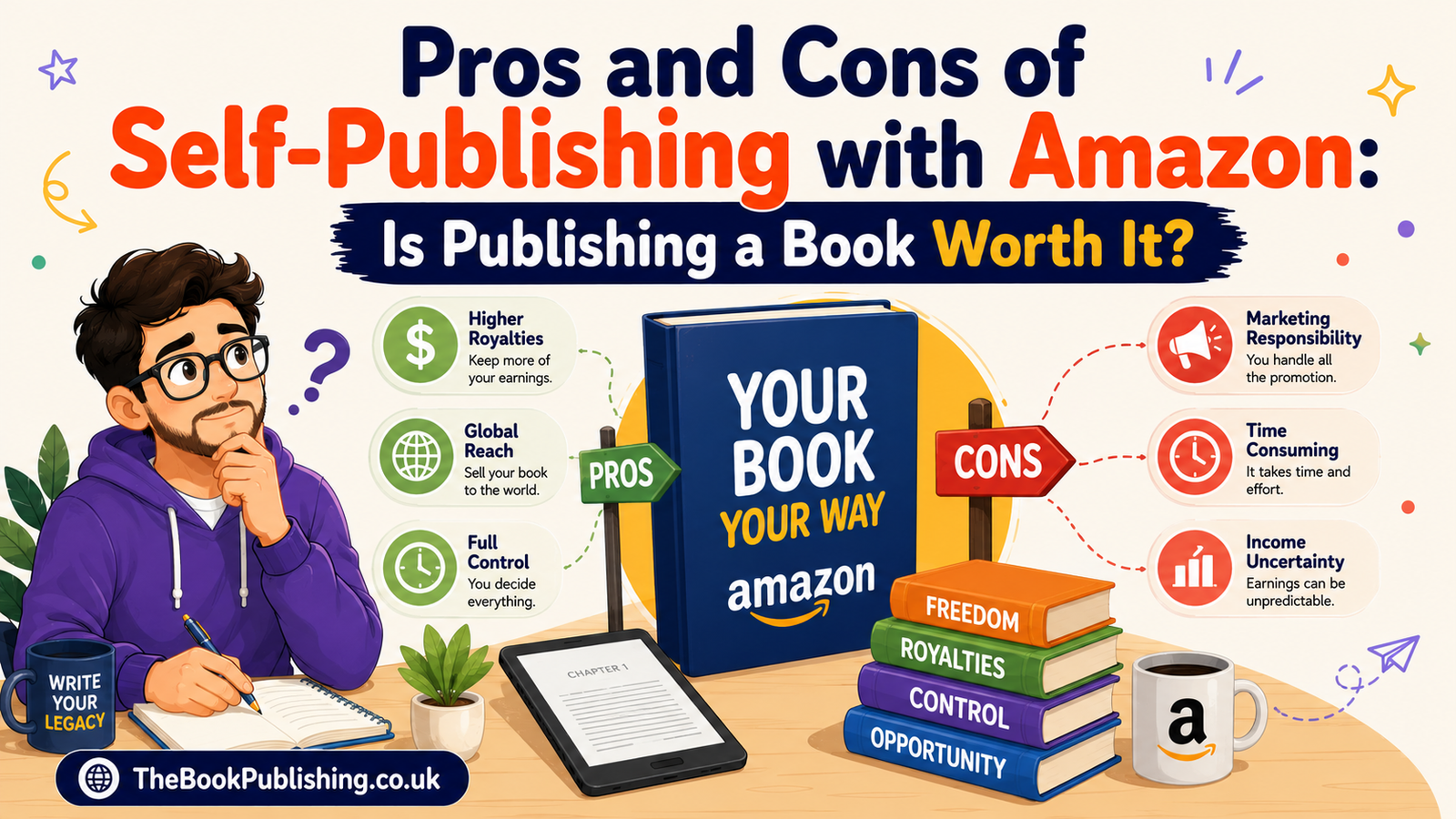
There are many pros and cons of self-publishing with Amazon KDP which people don’t know. Today, we will expose all the pros and cons of self-publishing with Amazon and guide you on what book publishing option is safe for you. Also, we will explain every aspect of self-publishing with Amazon in our guide and let you know if publishing a book is worth it.
What Does Self-Publishing with Amazon Actually Mean?
Before we start our guide for pros and cons of self-publishing with Amazon, let’s define what the meaning of self-publishing with Amazon is. In self-publishing with Amazon KDP, you have to manage every stage of book publishing, such as editing, cover design, formatting, pricing, and marketing. Amazon Kindle Direct Publishing is a popular platform that lets you publish your books without spending money. If you can handle every task from formatting to editing, you have to pay nothing now. Eventually, when someone purchases your book from the KDP listings, you get a certain amount of royalty. Self-publishing is quite different from the traditional publishing method because it gives you full control.
Pros of Self-Publishing with Amazon
In this blog, we are breaking down the pros and cons of self-publishing with Amazon. Let’s start this guide by understanding the major pros of self-publishing a book with Amazon KDP.
Full Control Over Your Timeline
Traditional publishing is so slow that it takes around 18 to 36 months from signing a contract with an agent to holding a physical copy in hand. Self-publishing, on the other hand, entirely removes all this waiting and lets you publish your book within weeks if you have already completed the manuscript. You have the freedom to set the deadline to publish a book; when you are done with cover designing, editing, formatting, and proofreading, you are set to publish on Amazon.
Higher Royalties Per Sale
The biggest reason most people choose self-publishing after looking at the pros and cons of self-publishing with Amazon is a higher earning opportunity. Traditional publishing does not pay as much as self-published books, depending on the book sales.
- Up to 70% eBook royalty on eligible pricing
- 35% royalty outside the qualifying price range
- 50 to 60% print royalty, minus printing costs
- Traditional publishers typically pay 10 to 15% on print sales
The Ability to Fix Mistakes Instantly
If you find any grammatical errors, cover issues, or formatting problems in your book after publishing, you can fix them easily with self-publishing on Amazon KDP. As KDP only prints your book when a reader buys from the listings, you lose nothing.
Complete Control Over Pricing and Distribution
You have full control over your book printing, which allows you to test different strategies and promotions. Additionally, you can decide yourself whether you want to earn through KDP or other publishing platforms as well, exclusively. Traditional publishing gives you no option to improve your quality of prints.
Freedom to Choose Your Own Team
You can hand-pick your editor, cover designer, and formatter with self-publishing rather than rely on an assigned publishing team. Also, you can find quality services provided on freelancing platforms and hire them according to your budget.
Cons of Self-Publishing with Amazon
As we are discussing the pros and cons of self-publishing with Amazon in our guide, it’s time to explore the major cons of self-publishing a book with KDP and why authors don’t like self-publishing.
You Cover Every Cost Yourself
In traditional publishing, you pay for nothing, and publishers manage the cost of editing, formatting, and cover designing. Meanwhile, for self-publishing, you have to manage your own budget for all these services and market your book. Additionally, if you want to publish your book outside Amazon KDP, then you have to purchase an ISBN for paperbacks.
It’s More Time-Consuming Upfront
Self-publishing can become a headache if you don’t have any idea how to hire your team. You need to do all the research and look for the best formatters, editors, cover designers, and manage all the marketing yourself. Traditional publishing handles all this with their professional team, and it costs you nothing upfront.
Marketing Is Entirely on You
Even if you work with traditional publishers, you have to do the most book marketing yourself. But for self-publishing, your book sales entirely depend on how well you promote your book. You have to run multiple ad campaigns on different social media platforms to gain positive feedback and sales, which can cost more.
Less Likely to Reach Physical Bookshops
You rarely find self-published books on book stores as they do not have a strong foundation behind them. However, in the case of traditional publishing, publishers offer high profits to bookkeepers, and it sells in the bookshops.
Self-Publishing vs Traditional Publishing: Quick Comparison
| Factor | Self-Publishing (Amazon KDP) | Traditional Publishing |
| Time to publish | Days to weeks | 18–36 months |
| Upfront cost to author | £500–£5,000 (your choice) | £0 |
| Royalty rate | Up to 70% (ebook), 50–60% (print) | 10–15% (print) |
| Creative control | Full control | Publisher decides |
| Error correction | Instant | Waits for next edition/reprint |
| Bookshop presence | Rare | More likely |
| Marketing responsibility | Entirely on the author | Mostly on the author, in practice |
Is Self-Publishing with Amazon Worth It?
You cannot easily tell whether self-publishing a book is worth it based on your scale for measuring success. Whether the book sells thousands of copies or a few, it all depends on your goals.
For business owners, coaches, and experts, a self-published book works like a credible tool and business card. When you have your own business book in the market, it helps you in consulting work, drives opportunities and creates unshakeable authority even if direct book sales stay modest.
For fiction writers and memoirists a self-publishng lets you be creative, gives you full control and lets you learn faster from reader feedback. But the earnings from the self published books are not so much. Many authors who aim for higher returns use multiple platforms with different titles to generate more money.
Financially, it’s worth setting realistic expectations. If you talk about making self-published or traditionally published book earning source alone, there are only a few authors who earn full-time income. However, if you choose Amazon KDP to self-publish your book, you get a nice amount of earnings as KDP has higher royalty rates, based on the volume of sales.
Final Thoughts
Finally in the end of this guide for pros and cons of self-publishing with Amazon, we conclude that it is worth publishing a book. The biggest pros of self-publishing a book with Amazon KDP are that you get speed, higher royalties, and total creative control. However, the biggest cons of self-publishing a book with Amazon KDP is you don’t reach bookshops easily, which is much easier in traditional publishing.
Meanwhile, it all depends on your choice after reading this detailed guide for pros and cons of self-publishing with Amazon. It’s not always about money when you want speed and full control over publishing a book. If you are looking for the most reliable self-publishing experts in the United Kingdom, don’t forget to contact TheBookPublishing.co.uk right now.
Frequently Asked Questions
Is it worth self-publishing a book on Amazon?
Before we answer this question, you need to define your goals for self-publishing a book on Amazon. Additionally, you need to learn all the above pros and cons of self-publishing with Amazon we discussed above. If you want to build authority, credibility, or a business tool, then choose self-publishing. However, if you plan to generate higher income, most authors shouldn’t expect it as a primary income source.
What are the biggest cons of self-publishing?
As we exposed many pros and cons of self-publishing with Amazon, the biggest cons include paying all the costs for services like formatting, editing and cover desing. Moreover,r you have to deal with all the marketing campaigns and run ads to sell more books. You rarely find self-published books in bookshops as they don’t have a good marketing budget. Amazon KDP prints your book on every reader purchase.
Do self-published authors earn more per book than traditionally published authors?
If you want to know the general earnings on every sale, then yes, KDP pays you up to 70% on eBook, and you get 50 to 60% on print. However, with traditional publishing, you can only generate 10 to 15% of the money through print royalties. The total earnings highly depend on th number os sales your book makes. You have to invest in marketing in case of self-publishing a book with Amazon.
