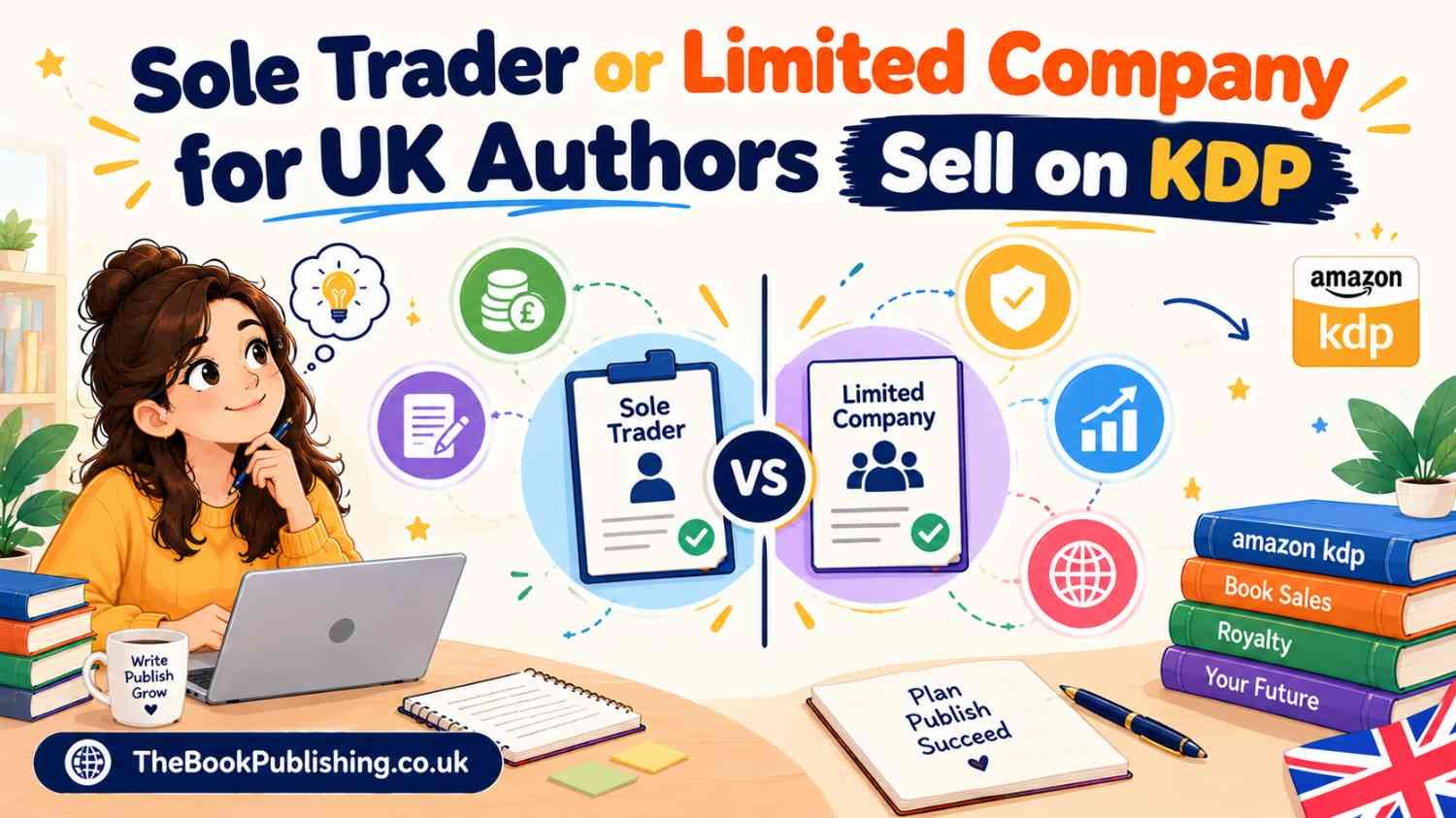
This guide breaks down whether you need to be a sole trader or limited company for UK authors to publish and sell your books on KDP. It explains the limited company status in detail and when each makes sense, with the cost behind the decision. To be clear at the start of this guide, UK authors dont require a limited company to sell books on Amazon KDP. But self-publishers register themselves with HMRC once royalty income passes £1,000 a year.
Key Takeaways
- First of all, comparing sole trader or limited company for UK authors becomes easy because you dont need business registration to publish on KDP. You need a pen name as an individual and hit the publish button.
- When your royalty payment exceeds the limit of £1,000 trading allowance in a tax year, only then do you need to register yourself as self-employed.
- Sole trader suits most authors below roughly £40,000 annual profit.
- Once your profit is comfortably into five figures, especially with liability or spousal income-splitting factors, your limited company becomes worth modelling.
Do You Need a Business Structure to Sell on KDP?
No, Amazon KDP requires no registered company; you can directly publish using a pen name. All you need is an imprint on your book covers while self operating and filing taxes as a real person.
The only HMRC obligation kicks in once your royalty income crosses £1,000 in a tax year; below that, the trading allowance means nothing needs reporting at all. Before knowing the difference between sole trader or limited company for UK authors, read our guide on how Amazon KDP works if you want to publish your books.
Sole Trader: The Default Setup for Most Authors
Time to compare sole trader or limited company for UK authors, and which one is right for you. If you are a sole trader, you need to report your royalties through Self Assessment and pay Income Tax on profit above your personal allowance. But the good thing is you have an option to deduct expenses such as editing, cover design, formatting, and advertising before tax is calculated.
Your personal assets are not protected for the long term if there is no legal separation between you and the business. However, the risk of losing income for most authors in publishing a book is low. After you start earning, the last date for registration is 5 October after the tax year; the tax return and payment deadline is 31 January.
Limited Company: When It Starts to Make Sense
Choice between sole trader or limited company for UK authors depends entirely on you. Because a limited company creates a separate legal entity, taxed via Corporation Tax, you can extract your money as salary and dividends in a limited company.
It adds real cost: Companies House registration, annual accounts, and typically £800 to £2,500 a year in accountancy fees, against roughly £200–£500 for a straightforward sole trader return.
The common range for tax by most accountants is almost £35,000–£45,000 annual profit. Keep in mind this figure is illustrative and before accountancy costs are added in.
Sole Trader or Limited Company for UK Authors: Quick Comparison
Here are the brief key points about both sole trader or limited company for UK authors, so it’s easy for you to choose one for your book:
| Sole Trader | Limited Company | |
| Setup required | None — register with HMRC once over £1,000 income | Companies House registration, ~£100 fee |
| Typical accountancy cost | £200–£500/year | £800–£2,500/year |
| Liability protection | None — personal assets exposed | Limited — company is separate legal entity |
| Privacy | Not publicly listed | Accounts filed publicly at Companies House |
| Best suited to | Most authors under ~£40k profit | Higher earners, liability concerns, spousal income-splitting |
When a Limited Company Is Worth Considering
The best option while you’re selecting a sole trader or limited company for authors is to know when to pick a limited company instead of investing money without any requirement:
- Annual profit is comfortably into five figures and climbing
- If you are working on high-liability content, for example, memoir naming real people or investigative non-fiction.
- A spouse can be involved, unlocking income-splitting and the Employment Allowance
- You want to retain profit in the business rather than extract it all immediately
- You’re planning to exit or sell the author business eventually
If your income is below these thresholds, then switching to a limited company for tax reasons is not worth it because it costs more.
Expenses You Can Claim Either Sole Trader or Limited Company for UK Authors
Whichever structure you use, you can deduct genuine business costs against your royalty income: editing, cover design, formatting, advertising, software subscriptions, and a reasonable share of home-office costs. Keeping clean records of these from day one reduces your tax bill regardless of which structure you choose.
No matter which structure you choose, from sole trader or limited company, for UK authors, you can deduct the business costs against your royalty income. Meanwhile, these deductions include the cost of book editing, cover design, formatting, advertising, software subscriptions, and a reasonable share of home-office costs. When you have clear data on all these services from the start, you end up reducing your tax bill no matter which structure you choose for book publishing.
US Tax and KDP: The W-8BEN Form
If you are operating in the UK as an author, you dont require any US business entity to publish your book on Amazon’s US store either. Submitting a W-8BEN form with your National Insurance details applies the UK-US tax treaty rate, so US tax isn’t over-withheld at source. This applies the same way whether you’re a sole trader or operating through a limited company.
Final Thoughts
The final choice between sole trader or limited company for UK authors depends on you. For a new start, go with sole trader; it is simple, low-cost and fine until profit climbs into five figures. Choose a limited company only if income, liability, or spousal tax planning make the added admin worthwhile. Get basic registration from HMRC when your income passes the £1,000 trading allowance in a single tax year.
For Free Consultation and Professional Book Publishing Services in the UK, check out TheBookPublishing.co. uk today.
Frequently Asked Questions
Do I need to register a business before publishing on KDP?
No. You can publish immediately under your own name or a pen name, and only need to register with HMRC once your royalty income exceeds £1,000 in a tax year.
Is a limited company worth it for a first-time author?
Rarely. For most debut and early-career authors, the extra accountancy cost outweighs any tax saving until profit reaches the tens of thousands.
Can I use a publisher name without setting up a company?
Yes, it’s not a big deal to use a publisher name without having your own LLC in the UK. All you need is a custom imprint or brand name on your book covers; no need for formal business registration until your profits reach a certain amount. You can work fine as an individual under Amazon KDP to publish your book without registering an LLC.
