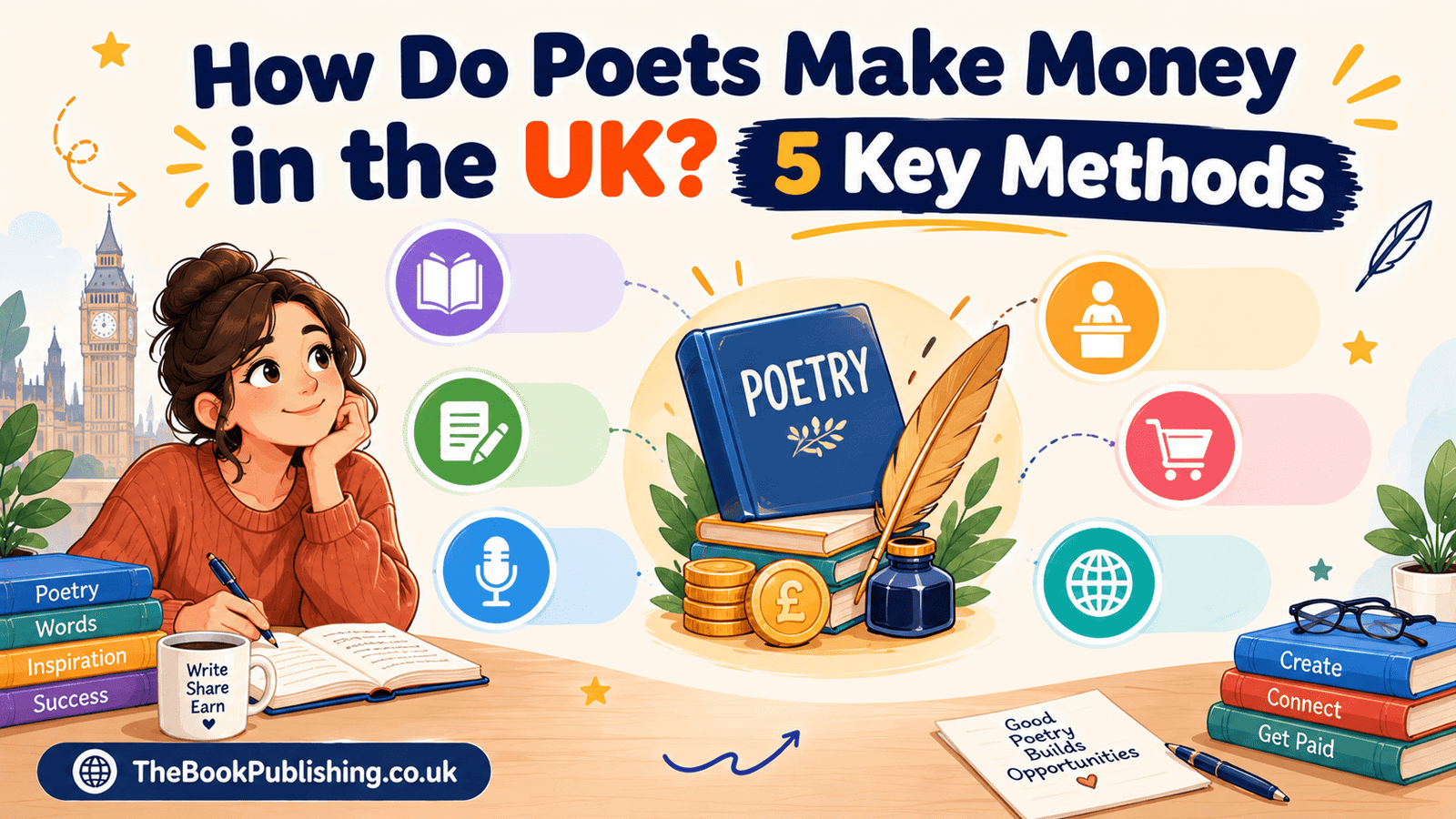
The famous ways how do poets make money include magazine and competition payments, Arts Council grants, live performance fees, teaching, and self-publishing on Amazon KDP all contribute. Poets earn money through many ways in the UK, from several streams at once rather than any single source. There are only a few poets who earn full-time income from poetry; that’s why experienced poets use multiple income streams at a time.
Key Takeaways
- Many famous UK poets combine magazine fees, competition wins, grant-funded work and self-publishing rather than depending on a single method of earning money through poetry.
- As a poet, you can earn money from Amazon KDP, up to 70% royalty on eBooks and 60% on paperbacks. But you have to exclude the printing costs as well from this percentage.
- Beyong fame, poets make money through T.S Eliot paying (£25,000 to Forward Prize for Best Collection of around £10,000. Likewise, you get the most prestigious poetry awards as well.
- ALCS research puts median UK professional author income at just £7,000 a year, but many poets earn money consistently less from winning alone.
5 Key Methods – How Do Poets Make Money in the UK?
Let’s talk about how do poets make money from poetry in the UK. UK poets usually earn money through these five methods we discussed below. Most authors who earn extra, they actually combine multiple channels of earning money through poetry instead of relying on a single one. Here is a whole list of how do poets make money:
1. Publishing in Literary Magazines
If you have started poetry recently and are wondering how do poets make money in the UK, the first way is through publishing in magazines and journals. Magazines and journals such as Poetry Review and The Stand pay a certain money on each published poem, usually around £20 to ££50. Although it seems low at first, more publications build a strong track record and increase payments. This track record play important role in getting selected in competitions by judges.
- Payment: £20–£50 per poem
- Best for: building credentials early
- Reliability: low pay, but low barrier to entry
In case you are looking for book editing services in the UK, look no further and visit TheBookPublishing.co.uk.
2. Entering Poetry Competitions
The second channel for how do poets make money is through participating in competitions and winning the reward money. You get larger single payments in competitions compared to publishing poetry in magazines. The T. S. Eliot Prize awards £25,000 for the best UK or Irish collection, with shortlisted poets receiving £1,500 each.
The Forward Prizes pay £10,000 for Best Collection and £5,000 for Best First Collection, plus £1,000 for Best Single Poem. Moreover, early career writers can find a good opportunity in research work by winning The Eric Gregory Award, for poets under 30.
- T. S. Eliot Prize: £25,000 (winner), £1,500 (shortlist)
- Forward Prize – Best Collection: £10,000
- Forward Prize – Best First Collection: £5,000
- Reliability: high reward, but very competitive odds
3. Applying for Arts Council Grants
Arts Council England’s Developing Your Creative Practice (DYCP) grants and Project Grants fund various type sof work, from a new collection, a membership, or dedicated writing time. It’s another way how do poets make money in the UK, with funding routes built specifically for writers rather than publishers. But their applications are competitive; you will need to work hard to get this chance.
- Funds: collections, mentorships, dedicated writing time
- Application-based, not guaranteed income
- Best for: funding a defined project rather than daily living costs
4. Live Readings, Residencies and Teaching
The next channel for poets to make money in the UK is through appearing in festivals like “Ledbury Poetry Festival” and Anday Festival”. Find more opportunities in these festivals like open-mic and spoken word nights, and paid residencies at universities. Get inspiration from poets running workshops through the Poetry Society or the Arvon Foundation. Meanwhile, you can even offer private manuscript mentoring, often a steadier income than performance fees alone.
- Festival/event fees plus travel expenses
- Paid residencies via universities, schools, libraries
- Workshop teaching and private mentoring for recurring income
For your poetry book marketing, you can get in touch with our professional team of digital and local marketers.
5. Self-Publishing on Amazon KDP
The last method of how do poets make money is through self-publishing poetry eBooks on the Amazon Kindle Direct Publishing platform. You must know the self-publishing is entirely free, you only have to spend money on book designing, editing, formatting, proofreading or marketing, if you cannot handle all these yourself. Ebooks priced £1.99–£9.99 earn a 70% royalty; paperbacks earn 60% minus printing costs, leaving roughly £3–£4 per copy on a typical slim collection.
No doubt, KDP pays much better than all the other channels for how poets make money, but readers don’t automatically find your book; you need to promote it. The sales of your poetry eBooks are based on how effectively you target your audience and maintain social platforms or a mailing list.
- Ebook royalty: 70% (£1.99–£9.99 price band)
- Paperback royalty: 60% minus print cost
- Reliability: depends entirely on the poet’s own promotion
For self-publishing your poetry books on Amazon KDP or book formatting services, you need to contact our support team, available 24/7 at your service.
Common Traps to Avoid When Submitting Poetry
After underng several ways of how do poets make money by publishing poetry or participating in festivals and compeitions, time to know the common mistakes to avoid:
- Paying “hybrid” publishers thousands to do what KDP offers for free
- Paid review services, which breach Amazon’s terms and risk account suspension
- Courses promising fast passive income from quickly assembled collections
- Submitting to competitions or magazines without reading recent issues first, wasting entry fees on a poor fit
Can Poets Make a Lot of Money?
Yes, there are a few famous poets such as Arch Hades, Simon Armitage, and Carol Ann Duffy, who are some of the highest-paid poets in the UK, earning up to £7,000 to £50,000 annually. But most poets earn a modest amount of money even after combining several sources like publishing in magazines, journals, or on Amazon KDP.
Comparing Different Ways of how Do Poets Make Money
| Income Source | Typical Payment | Reliability |
| Literary magazines | £20–£50 per poem | Low, but builds credentials |
| Major competitions | £1,000–£25,000 (one-off) | Very low odds, high reward |
| Arts Council grants | Project-based, varies | Competitive, application-only |
| Live readings/workshops | Fee + expenses, per event | Moderate, recurring potential |
| Amazon KDP self-publishing | 60–70% royalty per sale | Depends entirely on audience |
Final Thoughts
Finally, you know the answer to how do poets make money in the UK: mostly by combining several earning sources. Even if you are an aspiring poet, do not rely on a single earning medium; explore magazines, competitions, grants, live work, and self-publishing on Amazon KDP. The only smart poets are those who combine multiple income streams rather than waiting for the next competitions or festivals.
If you have made up your mind to self-publish your book on Amazon KDP or through traditional publishers checkout our top-notch book publishing services at TheBookPublishing.co.uk.
Frequently Asked Questions
How do poets make money in the UK?
Through a mix of magazine payments, competition prizes, Arts Council grants, live performances, teaching, and self-publishing royalties, rarely from just one source.
Can poets make a full-time living from poetry alone?
Very few do. ALCS research shows median UK author income has fallen well below minimum wage levels, and most poets combine writing with other paid work.
Is self-publishing on Amazon KDP a good option for poets?
Yes, self-publishing your poetry collections in the form of eBooks on Amazon KDP is the safest option, with no risk of losing money. In return, you get up to 60 to 70% royalties on every sale your book makes.
